
Velvet Realty Group Blog
Pricing Your San Antonio Home: Comps, the First Weeks, and When to Adjust
Texas sale prices are not public record, so a list price here is built from MLS closed sales, checked against the homes you compete with, and reviewed on a set date after listing. Sources read October 15, 2026.

The short version. A San Antonio list price should come from recent closed sales of homes like yours, pulled from the MLS, because Texas does not make sale prices public record. Check that price against the active listings you will compete with, see which buyer search ranges it lands in, and make sure it can hold up to a buyer's appraisal. Then set a date to review it. In September 2026, San Antonio-area homes averaged 88 days on market and closed at 92.4% of their original list price, so plan for a longer sale than a year ago.
This guide is for an owner in San Antonio or the northeast corridor, including Universal City, Schertz, Cibolo, Live Oak and New Braunfels, who is choosing a list price or rethinking one after the first weeks on the market. That includes military owners pricing a home ahead of a PCS move. It explains how pricing works here. It does not price your home. For the full selling process, see selling with Velvet.
Why Texas sale prices are not public, and where a pricing opinion comes from
You generally cannot look up what a Texas home sold for in a public record. Sale-price information that owners share with an appraisal district under a promise of confidentiality is "confidential and not open to public inspection" under Tax Code section 22.27, and sale-price data an appraisal district gets from a private source is exempt from public-records requests under Government Code section 552.149. The Bexar Central Appraisal District's residential FAQ says it "is prohibited from disclosing sales information gathered from a private source." All three were read October 15, 2026.
That has three practical effects for a seller:
- Closed prices come from the MLS. The prices that agents report when a listing closes are the main record of what homes like yours actually sold for. A licensed agent with MLS access pulls them for a comparative market analysis.
- Online automated estimates work with less. A website's instant value estimate cannot read Texas sale prices from public records, because those records generally do not carry them. Treat it as a starting question, not a list price.
- Your appraisal notice is a tax value. Texas appraisal districts value property "at its market value as of January 1," under Tax Code section 23.01. The value is set by mass appraisal across many homes, it is months old by the time most homes list, and a homestead's taxable value can be capped below market value under section 23.23. It is not a list price, in either direction.
How the comparable-sales set is built
A pricing opinion starts with a short list of homes a buyer would weigh against yours. Three kinds of listing go into it, and each tells you something different:
| Status | What it shows | How much weight it carries |
|---|---|---|
| Closed (sold) | The price a buyer actually paid, and usually any seller-paid concessions, as reported in the MLS | The core of the analysis. Appraisers work mainly from closed sales. |
| Pending (under contract) | A home a buyer agreed to buy, at a contract price that is not public until it closes | Shows where demand is right now, but the final price is still unknown |
| Active (for sale) | The homes your buyers will tour the same weekend as yours | Not evidence of value, since an asking price is not a sale. It is your competition. |
The closest comparable is usually a recent sale in the same subdivision, of similar size, age and condition. When there are not enough of those, the search widens to nearby subdivisions or a longer time window, and the agent explains why each home was kept or dropped.
No two homes match exactly, so each comparable is adjusted for the ways it differs from yours:
- Size: living area, bedroom and bathroom count, and garage spaces.
- Condition and updates: roof, HVAC, kitchen, baths and flooring, and whether repairs are pending.
- Lot: size, what it backs to (a greenbelt, a road, other yards), slope, pool and trees.
- Age and build: year built, builder, and construction type.
- Subdivision: HOA dues and amenities, special district taxes such as a MUD or PID, and distance to the roads you would use.
- Timing and terms: how long ago the comparable closed, and whether the seller paid concessions that pushed the recorded price up.
There is no fixed dollar value for a bedroom, a pool or a year of age that works across San Antonio. The adjustment comes from what the local sales show, and it should be explained in the pricing presentation, not asserted. If an adjustment looks large, ask which sales support it.
Two things that should not drive the comparable set: the price you need to net for your next home, and what a neighbor says their house sold for. The first is a budget question, covered in our cost to sell guide and our sell first or buy first guide. The second cannot be checked against a public record in Texas.
What September 2026 says about pricing room
The San Antonio Board of REALTORS (SABOR) released its September 2026 figures on October 9, 2026. They describe the "San Antonio area" as SABOR defines it, which is not the city limits and not one county. Read them as the backdrop for your home's own comparable sales, not as a price for it.
| Measure | September 2026 | Change from September 2025 |
|---|---|---|
| Closed sales | 2,793 | Down from 2,823 |
| Median price | $302,999 | Down about 2% |
| Average days on market | 88 | Up 11% |
| Close-to-original-list price | 92.4% | Not stated |
| Months of inventory | 5.95 | Not stated |
| Active listings | 17,155 | Up 4% |
| New listings | 4,172 | Up 3% |
| Pending sales | 2,091 | Down 16% |
Four of those numbers bear directly on a list price:
- Close-to-original-list price, 92.4%. On average, homes that closed in September sold for 92.4% of the price they first listed at. That is an average across every closed sale, including homes that were priced well and homes that cut their price more than once. It does not mean every home sells 7.6% under list, and it is not a reason to add 7.6% to yours.
- Average days on market, 88, up 11% from a year earlier. Homes are taking longer to sell than they did in September 2025. Plan your move and your carrying costs around that, not around a quick sale.
- Months of inventory, 5.95. Months of inventory is generally read as how long the current supply of listings would last at the recent pace of sales if nothing new came on. SABOR's release does not print its formula. A higher number means buyers have more homes to compare against yours.
- 17,155 active listings against 2,091 pending sales. Active listings rose 4% and pending sales fell 16% from a year earlier. Fewer homes are going under contract while more are on the market.
The same release reports Bexar County single-family homes separately: 1,839 sales, up 6% from a year earlier; a median of $282,680, down 4.8%; an average of $333,434, down 3.8%; and 5.4 months of inventory. SABOR did not publish a Bexar County days-on-market or close-to-list figure in this release. For the full monthly and weekly panels, see our market update page and the September 2026 market update.
None of these numbers is a forecast, and none is specific to your street, price range or home type. A subdivision in Schertz or Cibolo can move faster or slower than the San Antonio area as a whole. That is why the next step is your own comparable sales.
How search price filters decide who sees the listing
Most home search sites ask the buyer for a price range, and a listing outside that range never shows up in the buyer's results or saved-search alerts. So a list price decides which buyers see the home before any of them compare it with anything.
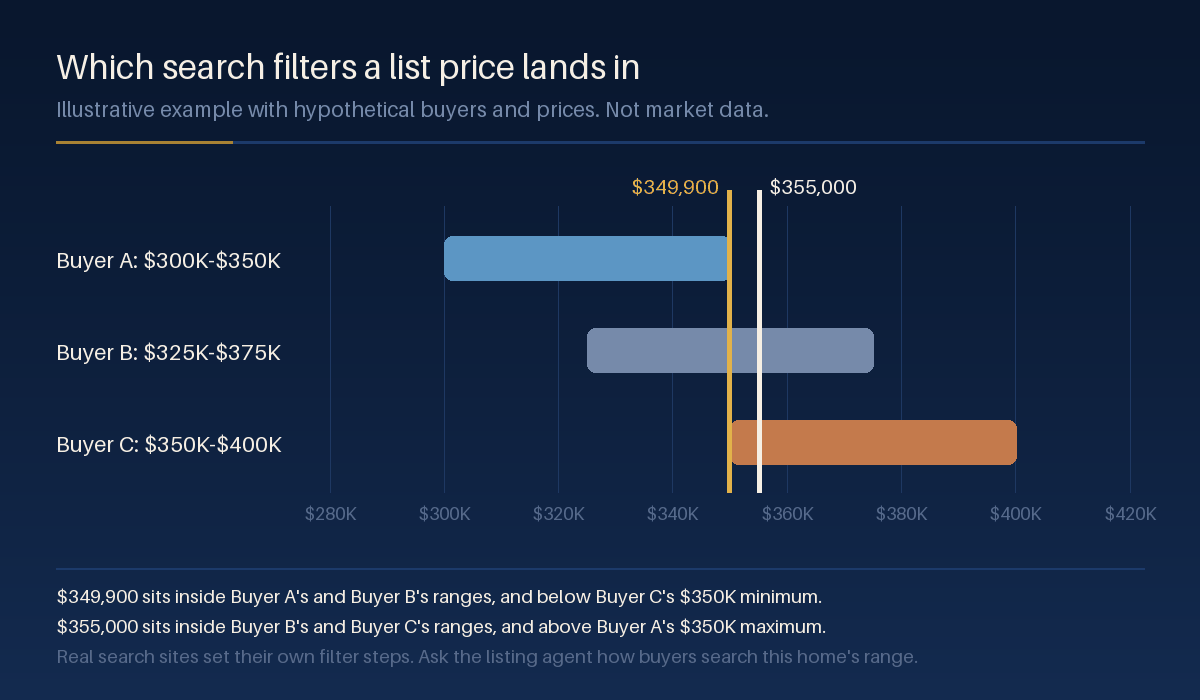
In the example, a home listed at $349,900 reaches Buyer A and Buyer B. The same home at $355,000 drops out of Buyer A's results and appears for Buyer C instead. Neither price is right or wrong on that basis alone. The question is which group of buyers is shopping for a home like yours, and where your comparable sales put it.
Search sites set their own price steps and many let buyers type any number, so there is no universal cutoff to aim for. Ask your listing agent how buyers in your range tend to search, and check where the price lands on the main search sites before the listing goes live.
How the appraisal fits in under Texas contract forms
If your buyer is financing, the lender orders an appraisal, and the contract price has to survive it. In most Texas resale contracts, financing terms sit in the TREC Third Party Financing Addendum, form 40-11, which replaced form 40-10. It is used with the One to Four Family Residential Contract (Resale), form 20-19. Both were read October 15, 2026. Here is what the forms say, in plain terms. Your own contract may add or change terms, so read it with your agent, and with a Texas attorney for legal questions.
Conventional and other non-FHA, non-VA loans
Under paragraph 2B of the financing addendum, "Property Approval," if the buyer's lender decides the property does not meet its underwriting requirements, "including but not limited to appraisal," the buyer may terminate "on or before the 3rd day before the Closing Date." The buyer must give notice and a copy of the lender's written statement of the reason, and the earnest money is refunded.
A low appraisal does not end the contract on its own. It opens three paths: the buyer brings more cash, the parties agree to a lower price or a split, or the buyer terminates under paragraph 2B. Which one happens is negotiated after the appraisal comes in.
TREC's separate Addendum Concerning Right to Terminate Due to Lender's Appraisal, form 49-1, lets the parties set that answer in advance, for non-FHA, non-VA loans only. The buyer can check one of three boxes:
- Waiver: the buyer gives up the paragraph 2B right to terminate over the appraised value. If the lender cuts the loan, the buyer's cash portion rises by the same amount.
- Partial waiver: the buyer gives up that right only if the appraised value is at or above a dollar figure written into the form.
- Additional right to terminate: the buyer may terminate within a set number of days after the effective date if the appraisal is below a stated figure, and gets the earnest money back.
For a seller, an offer with a waiver or partial waiver carries less appraisal risk than one without. Weigh it with the buyer's proof of funds: a waiver only helps if the buyer can actually cover the gap.
The resale contract's separate option period (paragraph 5B of form 20-19) gives the buyer an "unrestricted right to terminate" for a set number of days for any reason, appraisal included if it arrives in time. After that period, the financing addendum's terms govern.
FHA and VA loans
Paragraph 4 of the financing addendum carries the federal "FHA/VA Required Provision," often called the amendatory clause. The buyer "shall not be obligated to complete the purchase" or lose earnest money unless the FHA or VA appraised value is at least the amount written in, or, for VA, if the price exceeds the reasonable value VA establishes. The 3-day notice deadline in paragraph 2B does not apply to it.
- The buyer may still choose to close at the contract price and pay the difference. For VA, that difference must be paid in cash from a source disclosed to VA.
- For VA, the addendum also says the seller "may reduce the Sales Price" to the VA reasonable value and close at the lower price.
- Form 49-1 cannot be used to waive these rights, since it is limited to non-FHA, non-VA financing.
Both programs also give the buyer's side a formal way to send the appraiser more sales data:
- VA's Tidewater procedure. VA's Lenders Handbook, M26-7 chapter 10 (change date March 11, 2019, read from an archived copy of VA's PDF because VA's live handbook page would not load), requires the appraiser to notify the requester before finishing when the value appears to be below the sales price, and to allow "2-business days" for additional sales data. After the notice of value is issued, the veteran may request a reconsideration of value in writing. VA appraisals also check the home against VA's minimum property requirements; see our VA appraisal and MPR guide.
- FHA reconsideration of value. HUD Mortgagee Letter 2024-07 lets the borrower ask for one reconsideration of value per appraisal, offering up to five alternative comparable sales, resolved before closing. It applies to FHA case numbers assigned on or after September 2, 2024.
For a seller, the practical point is the same for every loan type: the closed sales that support your list price are the ones your agent can hand to the buyer's side if the appraisal looks low. A price that no closed sale supports has nothing to send.
When there may be no appraisal
Some conventional loans skip the appraisal. Fannie Mae's Selling Guide section B4-1.4-10, "Value Acceptance" (dated June 3, 2026, read October 15, 2026), says that "for certain loan casefiles," its underwriting system "offers value acceptance, in which case an appraisal is not required." Eligibility is decided loan by loan, the lender must still order an appraisal if it believes one is warranted, and some loans are excluded, including purchases of $1,000,000 or more and two- to four-unit properties. Do not count on it when you set the price: whether a buyer's loan gets value acceptance is not known until the lender runs it.
Reviewing the price after the listing goes live
Set a review date with your agent before the listing goes live, so the first conversation about price is a planned check, not a reaction to a quiet weekend. With an 88-day San Antonio-area average in September 2026, there is no fixed number of days that means a price is wrong. What matters is how your listing is doing against the homes it competes with.
At each review, compare:
- Showings: how many, and whether they are rising or falling week to week.
- Online activity: views and saves, if your listing platforms report them. Compare the trend on your own listing; one site's counts do not compare with another's.
- Feedback: what buyers and their agents said. Comments that the home is priced above others they toured carry more weight than comments about paint color.
- New competition: homes listed since yours in the same subdivision or price range, and how they compare.
- Price changes and contracts nearby: comparable homes that cut their price, went pending, or closed since you listed.
- Offers: whether any came in, at what price, and with what requests.
Then weigh four options with your agent. Each solves a different problem:
| Option | Fits when | Questions to ask |
|---|---|---|
| Change the price | Showings are low and similar homes are selling for less, or the home sits just above a common search range | Which closed sales support the new price? Which buyers does it reach that the old one missed? |
| Offer a concession | Buyers like the home but are stretched on cash to close, or a loan program allows seller-paid costs | How much does the buyer's loan allow? How does a credit compare with a price cut in my net? |
| Fix the condition | Feedback keeps naming the same repair or dated feature | What does the fix cost, and do the closed sales show buyers paying more for it? |
| Wait | Activity is healthy, or new comparable sales are about to close | What is it costing me per month to carry the home? What would change at the next review? |
Staging and photos are part of the condition question; our staging guide covers them. If your timeline is tight, our guide to selling sooner lists the other steps besides price.
A price cut or a concession: the difference in your net
A price cut and a seller concession of the same dollar amount usually leave a seller with close to the same net. They are not identical:
- A price cut changes the listed price, so it changes which buyers see the home in search. It also lowers the contract price the appraisal has to support. If your listing fee is a percentage of the price, that fee falls slightly too.
- A concession (a credit toward the buyer's closing costs, or a rate buydown) keeps the listed price and gives the buyer cash help at closing. The buyer's loan program caps how much a seller can pay, and the appraiser reports it.
Our seller concessions guide works the dollar comparison side by side, with each loan program's limits. Run your own numbers with your agent and your title company before deciding.
What to ask for in a listing agent's pricing presentation
A pricing presentation should show its work. Before you agree to a list price, ask for:
- The closed sales used, with addresses, close dates, sale prices, and any seller-paid concessions.
- The adjustment made to each one, in dollars, and why.
- The active and pending listings you will compete with, and how yours compares.
- The search range the recommended price falls in, and the range just above and below it.
- Recent figures for your area: days on market and close-to-original-list for homes like yours, not only area-wide averages.
- A dated plan for the first review: what will be measured, and on what date.
- How the price would hold up against an appraisal, and what happens under your contract if it does not.
- An estimate of your net at that price and at a lower one, before mortgage payoff.
A recommended price with no closed sales behind it is an opinion, not an analysis. Ask the agent to name the sales.
Before you set the price
- Get your seller's disclosure and repair records together first; our seller disclosure prep checklist lists them. Known repairs belong in the comparable-sales adjustments.
- Estimate your costs to sell so you know your net at each price; see our cost to sell guide.
- Ask for the pricing presentation items above, in writing.
- Agree on the first review date before the listing goes live.
For neighborhood and city context across the area, start from our San Antonio area guide.
Questions sellers ask
Can I look up what my neighbor's house sold for in Texas?
Usually not from a public record. Sale prices owners share with an appraisal district under a promise of confidentiality are closed to the public under Tax Code section 22.27, and the Bexar Central Appraisal District says it is prohibited from disclosing sales information gathered from a private source. A licensed agent can pull closed prices that were reported to the MLS.
Should I list at my appraisal district value?
No. The appraisal district's notice is a tax value set by mass appraisal as of January 1, and a homestead's taxable value can be capped below market value. Use recent closed sales of comparable homes instead.
Does 92.4% close-to-original-list mean I should price high and expect to come down?
No. SABOR's 92.4% for September 2026 is an average across all closed sales, including homes that cut their price. A price set above the comparable sales can miss buyers searching the right range and still has to clear the buyer's appraisal.
How long should I wait before lowering my price?
There is no fixed number of days. Set a review date with your agent before listing, then compare showings, online activity, feedback, new competing listings and nearby price changes and contracts. San Antonio-area homes averaged 88 days on market in September 2026.
What happens if the appraisal comes in below the contract price?
Under the TREC Third Party Financing Addendum, the buyer can bring more cash, the parties can renegotiate, or the buyer may terminate under paragraph 2B if the lender's underwriting is not met. For FHA and VA loans, the amendatory clause in paragraph 4 lets the buyer walk away without losing earnest money if the appraised value is below the stated amount.
Is a price cut better than a seller concession?
It depends on the problem. A price cut changes which buyers see the home and the price the appraisal must support. A concession keeps the price and helps the buyer with closing costs, within the limits of the buyer's loan program.
Sources
- San Antonio Board of REALTORS, September 2026 San Antonio market statistics press release (the file name says August; the release is dated October 9, 2026 and reports September 2026). Read 2026-10-15.
- Texas Tax Code section 22.27, section 23.01 and section 23.23; Texas Government Code section 552.149. Text read 2026-10-15 from the Legislature's official plain-text copies.
- Bexar Central Appraisal District, Residential Property Frequently Asked Questions (updated 2026-10-09) and notice of appraised value article. Read 2026-10-15.
- Texas Real Estate Commission forms 40-11 (Third Party Financing Addendum, 11-04-2024), 49-1 (Addendum Concerning Right to Terminate Due to Lender's Appraisal, 11-15-18) and 20-19 (One to Four Family Residential Contract (Resale)). Read 2026-10-15.
- Fannie Mae Selling Guide B4-1.4-10, Value Acceptance (06/03/2026). Read 2026-10-15.
- U.S. Department of Veterans Affairs, Lenders Handbook M26-7, chapter 10, Topics 8 and 22 (change date March 11, 2019), read 2026-10-15 from an Internet Archive copy of VA's own PDF; chapter 9, Topic 2 (escape clause). The live VA handbook page did not load for us.
- U.S. Department of Housing and Urban Development, Single Family Housing Policy Handbook 4000.1 (Update 18, revised August 12, 2026), amendatory clause; Mortgagee Letter 2024-07, Appraisal Review and Reconsideration of Value Updates (May 1, 2024). Read 2026-10-15.
Where these facts come from
| Market data | SABOR's September 2026 release for the San Antonio area, with its separate Bexar County single-family section. These are area-wide closed-sale figures, not a valuation of any home. |
|---|---|
| Rules and forms | Texas statutes, the appraisal district's own help pages, TREC promulgated forms, and the Fannie Mae, VA and HUD documents listed above, each read on 2026-10-15. |
| Examples | The search-range chart uses hypothetical buyers and prices. It is not market data. |
| Not yet documented | Whether VA's live M26-7 chapter 10 text still matches the 2019 archived copy; whether HUD has moved Mortgagee Letter 2024-07's borrower reconsideration terms into Handbook 4000.1; a Bexar County days-on-market or close-to-list figure for September 2026, which SABOR's release does not include. |
| Published | 2026-10-16 |
| Sources read | 2026-10-15 |
| Next review | When SABOR publishes its October 2026 release (monthly market figures), and by 2027-01-13 for the contract, loan-program and statute guidance (90 days), or sooner if TREC replaces form 40-11, 49-1 or 20-19. |
This article is general information, not legal, tax, appraisal or financial advice. It does not set a price for any home. Contract terms, loan rules and market figures change. Review your own contract with your agent, and with a Texas attorney for legal questions.
Velvet Realty Group is brokered by LPT Realty, LLC. Equal Housing Opportunity.
See the closed sales behind your list price.
Send us your address. We will pull the closed, pending and active MLS listings that compete with your home, show the adjustment for each, and set a dated review plan with you.