
Velvet Realty Group Blog
Boerne and Fair Oaks Ranch HOA Dues: Verify the Real Number
Three different charges get called “the HOA” in this market, and they arrive from three different senders. Here is how to pull the real number for one specific address before your option period runs out.
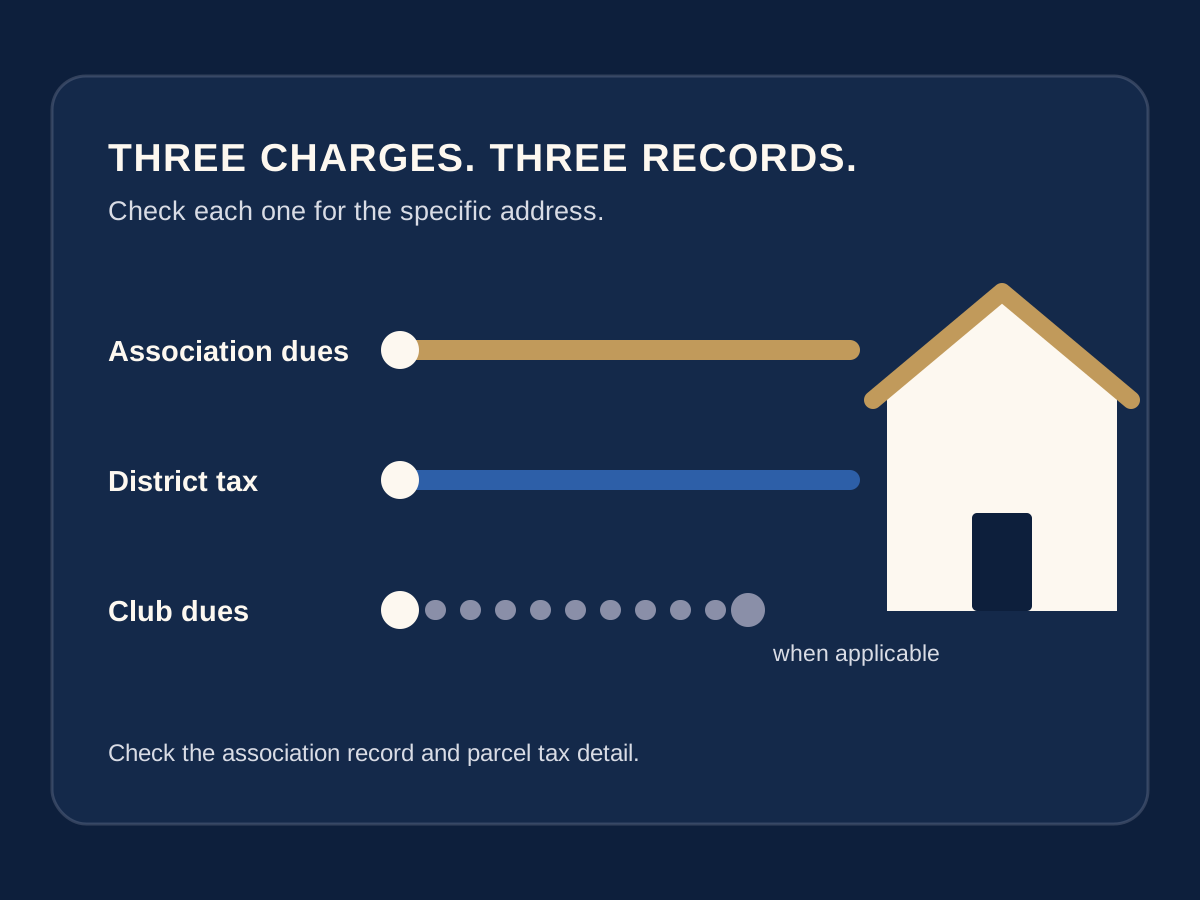
A buyer looking at a Boerne or Fair Oaks Ranch home might hear that the neighborhood dues are “about two thousand a year.” Before using that number to make a decision, the buyer needs to know exactly which charges it includes.
That figure cannot be evaluated on its own, because “about two thousand a year” may combine separate charges. In Boerne and Fair Oaks Ranch it is usually two or three charges that arrive separately, are adopted by different bodies on different schedules, and show up on different pieces of paper. One of them is billed by an association. One of them is a tax line on a county bill. One of them may not apply to you at all, or may be attached to the lot whether you want it or not.
So this page does not give you a list of subdivisions and dollar amounts. Any such list is wrong the next time a board adopts a budget, and you cannot check it. What it gives you instead is the sequence for getting the real numbers for one specific address, from the records you are entitled to, in time to act on them.
The three charges people keep confusing
Before you can verify anything you have to know which of these you are being quoted.
| What it is | Who bills it | Where it shows up |
|---|---|---|
| Regular assessment (POA or HOA dues) | The property owners' association | An invoice or statement from the association or its management company, at whatever frequency the association sets |
| Special-district tax (MUD, WCID, ESD, groundwater district) | The county tax assessor-collector, on behalf of the district | A separate line on your annual county property tax bill, at a rate per $100 of taxable value |
| Club or membership dues | The club, which is usually a separate entity from the association | A separate membership billing — and whether you can decline it depends on the recorded restrictions, not on the club's brochure |
The distinction matters for financing as well as for budgeting. A lender assembling your monthly housing expense will include property taxes — which is to say every taxing unit on that bill, special districts included — and a mandatory association assessment. A genuinely optional membership you can decline is not part of that housing expense. A membership that runs with the lot behaves like an assessment. Ask your lender directly how they intend to treat any membership obligation attached to the property; that answer belongs in writing before you are relying on a pre-approval amount.
First, find out which taxing units actually apply
This is the step most buyers skip, and in Fair Oaks Ranch skipping it is genuinely risky. The city limit spans three counties. The city's own truth-in-taxation page links the Comal County, Kendall County and Bexar County truth-in-taxation sites, which is the city telling you plainly that its residents do not all answer to the same county.

That has three consequences for a specific parcel:
- The appraisal district differs. Bexar, Comal and Kendall each have their own, and the parcel record showing which taxing units apply lives in whichever one the parcel actually sits in.
- The tax bill differs. Different counties, different county rates, and potentially a different set of districts layered on top.
- The homestead exemption is filed in a different place. You file with the appraisal district of record, not with the city.
Boerne is more straightforward — it sits in Kendall County — but the same discipline applies, because the district layer varies inside a single county too.
To settle it for one address: open the appraisal district's property search for the county you believe the parcel is in, look the property up by street address or account number, and read the list of taxing jurisdictions on the parcel record. That list, not the neighborhood name and not the listing remarks, is what determines the tax side of your monthly payment. If you are not sure which county to start with, the Texas Comptroller publishes a county-by-county appraisal district directory that confirms the district of record.
Second, request the subdivision information — and know the clock
If the property is subject to mandatory membership in a property owners' association, Texas law does not leave this to goodwill. Chapter 207 of the Texas Property Code gives you a right to the documents and gives the association a deadline.

Section 207.003 sets it out:
- Who can ask. An owner or the owner's agent, a purchaser of property in the subdivision or the purchaser's agent, or a title insurance company or its agent acting on behalf of the owner or purchaser. As a buyer under contract, you or your agent can make the request directly.
- What you get. A current copy of the restrictions applying to the subdivision, a current copy of the association's bylaws and rules, and a resale certificate.
- By when. Not later than the 10th business day after the written request is received.
- How fresh. The resale certificate must be prepared no earlier than the 60th day before it is delivered. An association cannot satisfy your request by forwarding last spring's certificate.
- Updates. An update must be delivered not later than the seventh business day after a written request for one. The request for an update has to be made within 180 days of the original certificate, and only by the party who requested that original.
- Fees. The section caps what the association may charge — a reasonable and necessary fee not to exceed $375 to assemble, copy and deliver the information, and not to exceed $75 for an update — and provides that no fee may be charged if the certificate is not provided in the time prescribed.
Count the ten business days against your option period, not against your closing date. Business days exclude weekends and holidays, so a request made on a Thursday before a holiday weekend can land two full calendar weeks later. Make the written request the day the contract is executed. That is the single highest-value thing on this page.
Third, read the resale certificate for what only it can tell you
A dollar amount someone quotes you is a single number with no date and no context. The resale certificate is a completed disclosure form with named line items. In a Texas resale transaction the document is the Texas Real Estate Commission's Subdivision Information, Including Resale Certificate for Property Subject to Mandatory Membership in a Property Owners' Association — TREC No. 37-5, which replaced TREC No. 37-4. Knowing it by name and number means you can ask for it precisely instead of asking someone to “send over the HOA stuff.”
Here is what its lettered items actually disclose, and why each one can change your decision:
| A — Right of first refusal or other restraint | Whether the restrictions contain a right of first refusal or another restraint on the owner's right to transfer. This one can affect your ability to resell, not just your budget. |
|---|---|
| B — Current regular assessment | The amount and its frequency. This is the line people quote as “the dues.” Without the frequency the number means nothing. |
| C — Special assessment due after delivery | An approved special assessment coming due after the certificate is delivered, what it is payable for and how. A regular assessment can look modest while a funded special assessment is landing next quarter. |
| D — Total unpaid on this property | Everything due and unpaid to the association attributable to this property. If the seller is behind, this is where it surfaces. |
| E and F — Capital expenditures and reserves | Approved capital expenditures for the current fiscal year, and the reserves held for them. Thin reserves against approved spending is how a special assessment arrives later. |
| G and H — Judgments and lawsuits | Unsatisfied judgments against the association, and pending lawsuits other than ad valorem tax suits of an individual member. |
| I and J — Violations and code notices | Whether the board has actual knowledge of conditions on the property that violate the restrictions, and whether the association has had notice from a governmental authority about health or housing code violations. |
| K — Transfer fees | The administrative transfer fee for a change of ownership, plus a description of all fees associated with the transfer — each fee, who it is payable to, and the amount. |
Item K is worth dwelling on, because transfer, resale-certificate and account-setup fees are real money at closing and they surprise people. Who pays them is a negotiated term in the Texas contract, not a fixed rule. Once item K tells you what they are, that is something your agent can actually negotiate rather than something you absorb at the closing table.
Fourth, check the special-district layer — and do not assume
The Texas Comptroller runs a Special Purpose District Public Information Database, created in compliance with Government Code Section 403.0241. You can search it by entity name, city or county and read a district's reported tax rate and outstanding debt.
Two things about it matter. The first is the Comptroller's own disclaimer, which we are quoting rather than paraphrasing, because it is the caveat an unattributed rate can never carry:
The information presented on the Comptroller's website and retrievable using the Special Purpose District Public Information Database is self-reported by submitting entities or third parties on their behalf and has not been independently verified by the Texas Comptroller of Public Accounts.
Treat it as a lead, then confirm the number against your actual county tax bill and the district itself.
The second is what the data actually shows for this area, because it cuts against the assumption most buyers arrive with. We pulled the database's raw files on September 22, 2026 and read the 2026 report-year records for districts listing Boerne or Fair Oaks Ranch as their city:
| District | Type | Reported total rate per $100 |
|---|---|---|
| Bexar County Emergency Services District #4 | Emergency services district | 0.064607 |
| Cow Creek Groundwater Conservation District | Groundwater conservation district | 0.005000 |
| Kendall County WCID No. 2, 2A, 2B, 3A, 3B, 4 and 4A | Water control and improvement districts | 0.000000 |
| Kendall County Fresh Water Supply District #1 | Fresh water supply district | 0.000000 |
| Fair Oaks Ranch Municipal Development District | Municipal development district | 0.000000 |
Read that middle row again. Seven Kendall County water control and improvement districts reported a total ad valorem rate of zero. A district can exist, serve your subdivision, and recover its costs through water and sewer service charges rather than a tax line. “There's a WCID out there” is not, by itself, a reason to add anything to your monthly payment — and equally, the absence of a district name in a listing is not proof that no district applies. Only the parcel record and the tax bill settle it.
The emergency services district row is the opposite lesson. At 0.064607 per $100, on a taxable value of $500,000, that is about $323 a year, or roughly $27 a month, that most buyers never hear mentioned during a showing.
What the city actually publishes
For Boerne, the city publishes its current rates broken out by taxing entity. As of September 22, 2026 that page is headed Tax Year 2025 and states these rates per $100 of taxable value:
| City of Boerne | 0.4716 |
|---|---|
| Kendall County | 0.377 |
| Boerne Independent School District | 1.0109 |
| Cow Creek Groundwater Conservation District | 0.005 |
Note what we did not do there: the city does not publish a combined figure, so we have not invented one for you to carry around. If you want the arithmetic, the four rates above sum to 1.8645 per $100, which on a taxable value of $500,000 is $9,322.50 a year, about $777 a month. That sum is ours, not the city's, and it is only meaningful after exemptions — taxable value means value after any exemption has been subtracted, and the school-district portion in particular changes materially once a homestead exemption is on the property. Our Texas homestead exemption guide covers the filing, and our property tax guide covers how the bill is assembled.
One independent cross-check worth noticing: Cow Creek Groundwater Conservation District's rate appears as 0.005 on the City of Boerne's page and as 0.005000 in the district's own filing to the Comptroller. Two sources, same number. That is what a verified figure looks like, and it is the standard to hold every other number on your list to.
Fair Oaks Ranch publishes its own truth-in-taxation material, and its schedule is a live demonstration of why a dollar list goes stale. As of September 22, 2026 the city's page showed the 2026 Tax Rate Notice with a no-new-revenue rate of $0.286132 per $100 and a voter-approval rate of $0.339407 per $100, certified on August 3, 2026 by the office of the Bexar County Tax Assessor-Collector — and it showed the second reading and adoption of the FY 2026-27 budget and tax rate scheduled for that same day. In other words, on the day we read the page, the adopted 2026 city rate did not exist yet. We are not publishing one. Go to the city's page and read the adopted figure.
Also worth knowing if you are searching from out of the area: the City of Fair Oaks Ranch has moved its website from fairoaksranchtx.org to fairoaksranch.gov. Older links still resolve, but the .gov address is the current one.
What this does to your payment and your loan
Recurring charges do not only cost you the charge. They cost you borrowing power, because a lender fits your total monthly housing expense inside a ratio, and every dollar of assessment or district tax is a dollar that is not available for principal and interest.
Using the payment arithmetic on our San Antonio buying power page: on a 30-year fixed loan at 6.5%, one dollar of monthly payment supports about $158 of loan principal. Run that backwards and the cost of a recurring charge becomes concrete.
| Monthly recurring charge | Approximate loan amount it absorbs |
|---|---|
| $50 a month | about $7,900 |
| $100 a month | about $15,800 |
| $200 a month | about $31,600 |
| $27 a month (the emergency services district above, on a $500,000 taxable value) | about $4,300 |
A $100 monthly assessment plus that district line is roughly $127 a month, or about $20,000 of loan amount. That is the difference between two price brackets, and it is decided by documents you can read during the option period. Your lender sets your actual qualifying numbers; the point here is only that the assessment is not a rounding error.
When there is no association, or a voluntary one
Parts of this market are genuinely unrestricted, and some associations are voluntary rather than mandatory. That is a real advantage for some buyers — and it is also where people get careless.
The absence of a bill is not proof there is no obligation. Confirm it affirmatively, in writing, by doing one of two things:
- Read the recorded restrictions. Deed restrictions and declarations are recorded in the county clerk's real property records for the county the parcel sits in. What binds the lot is what is recorded against it.
- Get it from the association in writing. If an association exists at all, ask it to state in writing that membership is voluntary and that no assessment runs with the lot. A verbal “nobody pays that out here” is not a record.
Worth knowing: the Chapter 207 delivery machinery above applies to properties subject to mandatory membership. If membership is voluntary, you may not have a statutory lever — which is exactly why you want the recorded restrictions rather than a conversation.
A per-address verification checklist
Run this on any Boerne or Fair Oaks Ranch listing you are serious about. Dates matter: write down when you checked each item, because every one of these is adopted or restated annually.
| 1. Make the written request immediately | Request subdivision information and the resale certificate in writing the day the contract is executed. The 10-business-day clock does not start until the request is received. |
|---|---|
| 2. Pull the parcel record | Find the property in the correct county's appraisal district and write down every taxing jurisdiction listed on the parcel record. |
| 3. Look up each district you did not recognize | Search the Comptroller's special-district database by name. Note the reported rate and that the data is self-reported. |
| 4. Read the certificate line by line | Items B and C for the assessment and any special assessment; D for amounts unpaid; E and F for capital spending against reserves; K for every transfer fee and who it is payable to. |
| 5. Confirm any membership obligation | Establish in writing whether a club or membership is optional or runs with the lot, and ask your lender how they will treat it. |
| 6. Take the total to your lender | Give them the monthly assessment and the full taxing-unit list before you rely on a pre-approval amount. |
| 7. Negotiate the transfer fees | Who pays them is a contract term. Raise it while you still have leverage. |
| 8. Re-check next year | Associations adopt budgets and taxing units adopt rates annually. A number verified today is a number verified today. |
What this page is not
It is not tax, legal, or financial advice, and it is not a promise of loan approval or of any particular payment, rate, assessment, or outcome. It does not state the dues, membership cost, or district tax for any named subdivision, because those are set by individual boards and taxing units, change annually, and can only be verified for a specific parcel. Every rate quoted above is labeled with the body that published it and the date we read it; confirm each against its source before you act on it. Nothing on this page evaluates any school, neighborhood, or the people who live in one.
Where these figures come from
| Chapter 207 rights and deadlines | Texas Property Code Section 207.003. The official Texas Statutes site now serves a JavaScript application with no static document at its published address, so the section text was verified against two independent full-text compilations that agree on every operative figure quoted here. Read 2026-09-22. Confirm the current section text before relying on the fee caps. |
|---|---|
| Resale certificate contents and form number | Read directly from the TREC form PDF, Subdivision Information, Including Resale Certificate, TREC No. 37-5, which states on its face that it replaces TREC No. 37-4. Items A through K are as printed on the form. Read 2026-09-22. |
| City of Boerne rates | City of Boerne Current Tax Rates page, headed Tax Year 2025. Read 2026-09-22. The city publishes no combined rate; the 1.8645 sum and the dollar figures derived from it are our arithmetic and are labeled as such. |
| Fair Oaks Ranch figures | City of Fair Oaks Ranch Taxes (Truth-in-Taxation) page and its linked 2026 Tax Rate Notice. Read 2026-09-22, on which date the page showed adoption of the 2026 rate scheduled for that same day. No adopted 2026 city rate is stated here. |
| Special district rates and debt | Texas Comptroller Special Purpose District Public Information Database, 2026 report year, read from the database's published raw data files on 2026-09-22. The Comptroller states this data is self-reported and not independently verified. |
| Cow Creek cross-check | 0.005 on the City of Boerne page and 0.005000 in the district's 2026 Comptroller filing. Two independent sources, read 2026-09-22. |
| Loan-amount arithmetic | Standard amortization at 6.5% over 360 months, giving about $158.21 of principal per $1 of monthly payment. Illustrative only; rates change and your lender sets your actual figures. |
| Published | 2026-09-23 |
| Modified | 2026-09-23 |
| Data through | 2026-09-22 for every rate, statute, form, and database figure on this page. |
| Last reviewed | 2026-09-22 |
| Next review due | 2026-10-23, and sooner for the Fair Oaks Ranch rate, which was scheduled for adoption the day this page was written. |
| Corrections | If a figure on this page does not match its source, tell us and we will correct the page, restate the corrected figure, and update the review date above. |
Sources
- Texas Property Code, Chapter 207, Disclosure of Information by Property Owners' Associations, Section 207.003, for who may request subdivision information, the 10-business-day delivery deadline, the 60-day certificate freshness limit, the 7-business-day update deadline, and the fee caps. Read 2026-09-22.
- Texas Real Estate Commission, Subdivision Information, Including Resale Certificate for Property Subject to Mandatory Membership in a Property Owners' Association, TREC No. 37-5, for items A through K. Read 2026-09-22.
- Texas Comptroller of Public Accounts, Special Purpose District Public Information Database, created in compliance with Government Code Section 403.0241, for district-reported tax rates and debt and for the self-reporting disclaimer quoted above. Read 2026-09-22.
- City of Boerne, Current Tax Rates, for the Tax Year 2025 rates by taxing entity. Read 2026-09-22.
- City of Fair Oaks Ranch, Taxes (Truth-in-Taxation) and its linked 2026 Tax Rate Notice, for the 2026 no-new-revenue and voter-approval rates, the certifying office, and the adoption schedule. Read 2026-09-22.
- Appraisal district property searches, for the taxing units that apply to a specific parcel: Kendall Appraisal District, Bexar Appraisal District, and Comal Appraisal District. Read 2026-09-22.
- Texas Comptroller of Public Accounts, county appraisal district directory, for confirming the appraisal district of record for a county. Read 2026-09-22.
Related guides
Our Boerne area guide covers the market these costs sit inside. For the payment arithmetic behind the loan-amount table above, see interest rates and San Antonio buying power. For the tax side, our Texas property tax guide and homestead exemption guide explain how the bill and the exemptions work, and what it takes to buy a $500,000 home puts the whole monthly number together.
Get these documents pulled for a specific address
If you are under contract or about to be, send us the address. We will make the written request, pull the parcel record from the correct appraisal district, and walk the certificate with you line by line while the option period is still open. Your lender confirms the qualifying numbers; we make sure you have the documents to give them.
Get the real number before your option period ends.
Send us the address. We will request the subdivision information and resale certificate, pull the parcel record from the right appraisal district, and go through what comes back with you.